While often perceived as an insular communist state, China has rapidly evolved
into a global leader in technological and digital innovation. Its developmental trajectory - from the advent of high-speed bullet trains to the expansion of a vast digital economy- offers profound lessons for Sri Lanka.
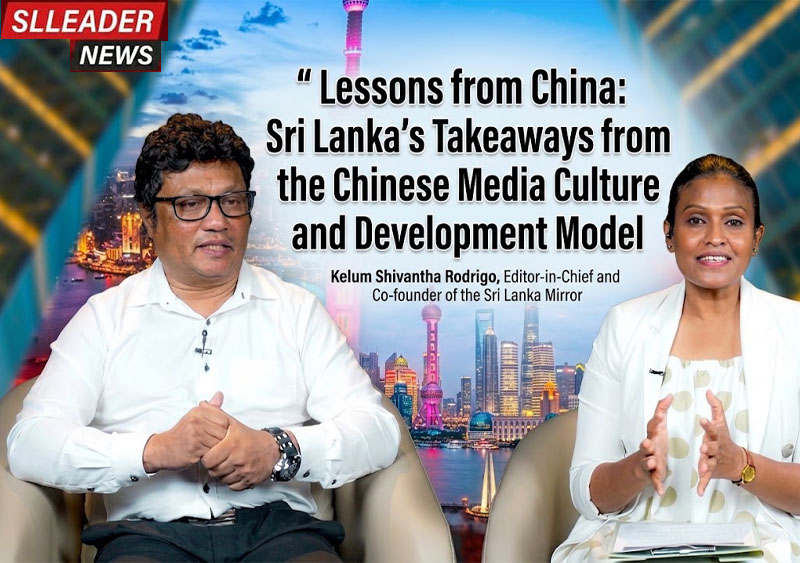
Kelum Shivantha Rodrigo, Editor-in-Chief and Co-founder of the Sri Lanka Mirror news portal, holds the distinction of being the first Sri Lankan journalist to visit China following the COVID-19 pandemic. In a recent interview with the Siya Netha Roo YouTube channel, Rodrigo shared extensive insights into China’s development and media landscape. He emphasized that while Sri Lankan media frequently limits itself to highlighting societal flaws, China's media culture serves as a powerful paradigm, actively steering the public toward national progress and a visionary future.
The discussion also highlighted recent media collaborations between Sri Lanka Mirror and international Chinese networks, including CCTV+ and WCICO (Western China International Communication Organization). Furthermore, it explored China's monumental infrastructure projects, notably executed while meticulously preserving the unique cultural identities of its diverse provinces.
“If we are to emulate anything, we must emulate China’s development model. Only then can we move at least a step forward,” Rodrigo asserted, delivering a resonant message to Sri Lankan youth.
An edited transcript of the comprehensive video interview is provided below.
Siya Netha Roo: Today on the Siya Netha Roo YouTube channel, we are speaking with an experienced journalist who has gained broad insights into international media and development. He is Mr. Kelum Shivantha Rodrigo, Editor-in-Chief and Co-owner of Sri Lanka Mirror. Welcome!
What are your current professional engagements?
Kelum Shivantha: The media sector is highly demanding at present due to ongoing political crises, particularly concerning the prison system. Additionally, as part of a new collaborative initiative with China, a delegation is scheduled to visit Sri Lanka from the 14th to the 18th of this month. We are currently preparing for that unique media engagement.
Siya Netha Roo: In 2016, you visited China and experienced a bullet train journey. What were your initial impressions?
Kelum Shivantha: Prior to my visit in 2016, I lacked a profound understanding of the country. Like many Sri Lankans, I harbored the misconception that China was a closed-off, communist nation. However, traveling on a bullet train from Beijing to Shanghai completely shifted my perspective. Once aboard, the train remains completely stable until it reaches the next station. The sheer civic discipline observed within the stations and the advanced technology utilized are phenomena we still lack in Sri Lanka. Upon subsequent visits, I witnessed even further technological leaps, highlighting just how far ahead China truly is.
Siya Netha Roo: You were the first Sri Lankan journalist to visit China following the COVID-19 pandemic. Could you elaborate on this?
Kelum Shivantha: Indeed, I traveled to China in 2022, a time when traveling required wearing full PPE suits. I was privileged to participate in a six-month residential program organized by the CIPCC (China International Press Communication Center). This provided a remarkable opportunity to conduct a comprehensive study of the country. I was able to observe multifaceted aspects of Chinese life, ranging from dietary habits and cultural nuances to sports.
Siya Netha Roo: How did that experience influence your journalistic career in Sri Lanka?
Kelum Shivantha: Within Sri Lanka, various narratives have been constructed regarding China. However, I observed that Chinese television and print media consistently prioritize 'development.' They frequently engage in discourse regarding the future progress the nation must achieve. Conversely, Sri Lankan media is often fixated solely on exposing systemic flaws, lacking constructive dialogue on the way forward. The monumental development China achieved within a decade is rooted in its long-term strategic planning and profound trust in technology. That specific development model is exactly what Sri Lanka must adopt—nothing else.
Siya Netha Roo: How did you perceive the cultural diversity across China's various provinces?
Kelum Shivantha: I visited several cities, including Beijing, Shanghai, Chongqing, Tianjin, Chengdu, Hangzhou, Xi'an, Kunming, and Urumqi. The scale of development and cultural characteristics vary significantly between cities. For instance, in the Urumqi region, home to a prominent Muslim population, modernization has advanced while meticulously preserving their ancient heritage and traditional architecture. Modern technology has been seamlessly integrated into traditional agriculture. In coastal regions heavily reliant on the fishing industry, such as Shandong, massive wind power installations have been established. Meanwhile, in a bustling metropolis like Beijing, daily logistics—from food delivery to freight—are managed entirely through sophisticated digital applications to accommodate the fast-paced lifestyle.
Siya Netha Roo: Could you share your experience collaborating with Chinese media networks?
Kelum Shivantha: About seven years ago, we engaged in a cooperative program with China's CCTV+ network. Through Sri Lanka Mirror, we set a benchmark for forging partnerships with advanced international media organizations. Today, our portal features a dedicated section for CCTV+, where we provide Sinhala-narrated content for the local audience. We are conducting a similar collaborative program with WCICO in Chongqing. I can proudly state that we remain the only digital news platform in Sri Lanka to dedicate distinct web sections to both China's national and regional television networks.
Siya Netha Roo: Who were the key figures supporting you behind these experiences?
Kelum Shivantha: I must first extend my gratitude to Mr. Nalin Aponsu, President of the Sri Lanka-China Journalists' Forum, and his team for facilitating this opportunity. I am equally grateful to Mr. Yu Lei, Director of the CIPCC, who provided tremendous support in forging these connections. Furthermore, I wish to thank the CCTV+ team, who has collaborated with me for over seven years, alongside the WCICO team we are currently engaged with.
Siya Netha Roo: What is your message to Sri Lankan youth, particularly those aspiring to enter the media industry?
Kelum Shivantha: Sri Lanka is a small island nation, acquiring international exposure inevitably requires traveling abroad. Domestically, there is a distinct lack of long-term strategic planning. Therefore, my advice to the younger generation is clear. if we are to emulate anything, we must emulate the Chinese development model. Doing so will enable us to take at least a meaningful step forward.