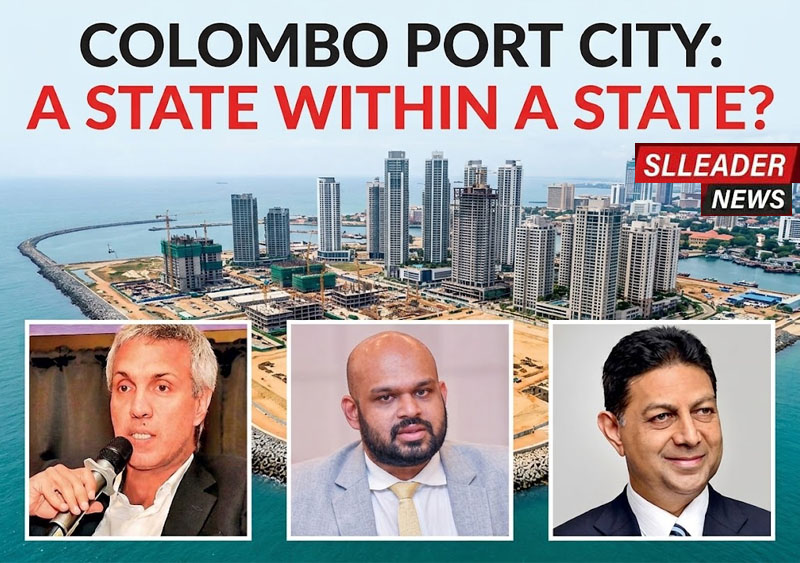
Why is the current government preserving the Rajapaksa regime’s arbitrary structures?
A grave question has once again resurfaced regarding the true status
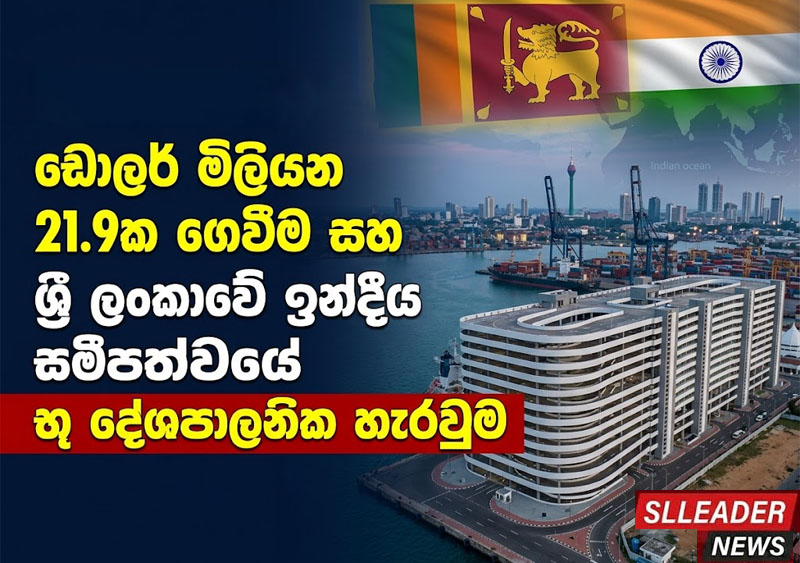
of the Colombo Port City (Port City): Is it a territory truly subject to the laws of Sri Lanka, or is it a separate state operating entirely without transparency?
The immediate catalyst for this renewed scrutiny is a series of illegal and arbitrary appointments within the Colombo Port City Economic Commission (CPCEC).
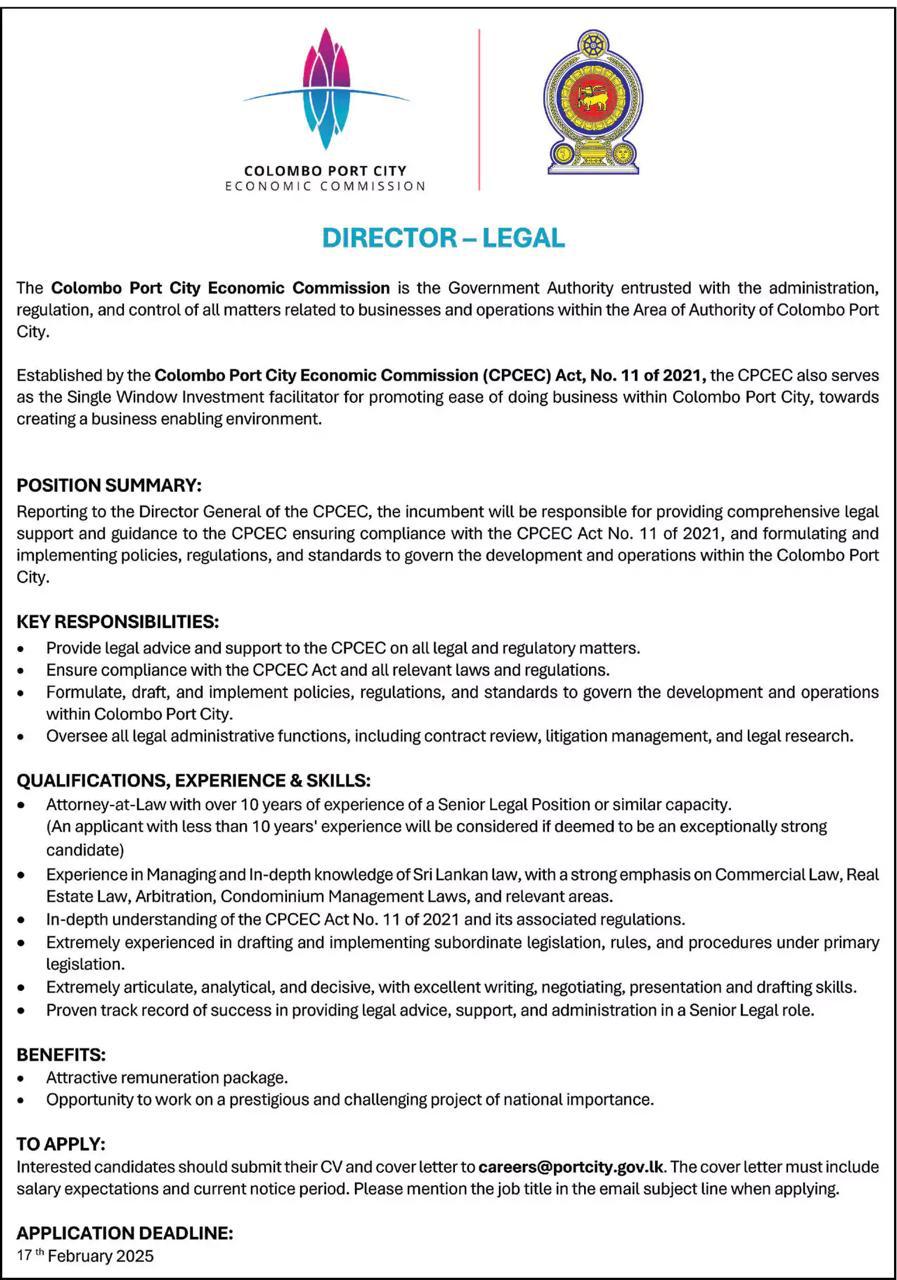
Of particular concern is the fact that despite the positions of ‘Director of Commercial and Operations’ and ‘Director of Legal’ falling vacant simultaneously, and despite applications being called for both, the Commission moved to fill only one—the Commercial Director post. By keeping the Legal Director position vacant for nearly two years and high-handedly assigning its duties to the newly appointed Commercial Director, the Commission has engineered a massive crisis of governance.

Ms. Radika Obeyesekere
The gravity of this situation is compounded by the fact that the appointee for Director of Commercial and Operations, Ms. Radika Obeyesekere, does not possess the basic qualifications prescribed for the post by the Commission itself.
The Commission’s own advertisement sought a candidate with a Master of Business Administration (MBA) or an equivalent qualification, alongside high-level management experience in the commercial sector. Ms. Obeyesekere, however, holds only a Bachelor of Laws (LLB) degree from the University of London and a Diploma in Marketing. Given her complete lack of practical experience in large-scale, market-driven commercial operations, her appointment to this pivotal role remains a major puzzle.
Furthermore, the situation becomes even more alarming when examining the legal functions she is currently "covering" in an acting capacity. According to the Commission’s regulations, a Legal Director must possess over a decade of senior legal experience in specialized fields such as commercial law, property law, and arbitration. While Ms. Obeyesekere is a qualified lawyer, her professional career has been spent in administrative and executive roles, not in legal counsel or legislative drafting.

This presents a stark contrast to her predecessor, Ms. Vindhya Weerasekera, a highly qualified professional with 26 years of legal experience and a Master of Laws (LLM) in International Trade Law. The critical question is this: following the departure of such a qualified officer, what is implied by the Commission entrusting legal powers, without any formal recruitment process, to a Commercial Director who lacks the essential qualifications for either role?
Within the framework of the Port City, the Legal Director is responsible for providing independent legal oversight on contracts, property transfers, and administrative functions. Entrusting this oversight to the very official managing commercial operations is akin to, as the local proverb goes, "asking the thief’s mother for assurance."
It is no coincidence that the legal department, which is mandated to independently scrutinize management decisions, has been absorbed into the management structure itself. This makes it abundantly clear that independent legal transparency is viewed as a hindrance by the Commission.
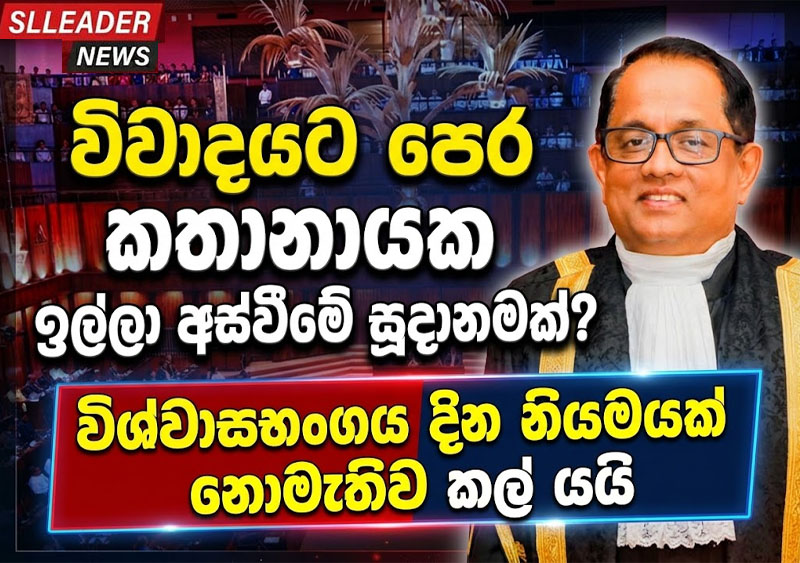
Opposition Member of Parliament, Hon. Shanakiyan Rasamanickam, recently raised these serious concerns on the floor of the House. He vehemently questioned the legality of decisions made by a massive Commission operating without proper legal oversight.
Furthermore, MP Rasamanickam revealed that authorities refused to provide individual salary details of Commission officials upon inquiry, providing only the total salary expenditure to conceal specific information. Parliamentary discussions regarding state bank loan write-offs and the overall control of the Port City highlight the massive irregularities and total lack of accountability within this institution.
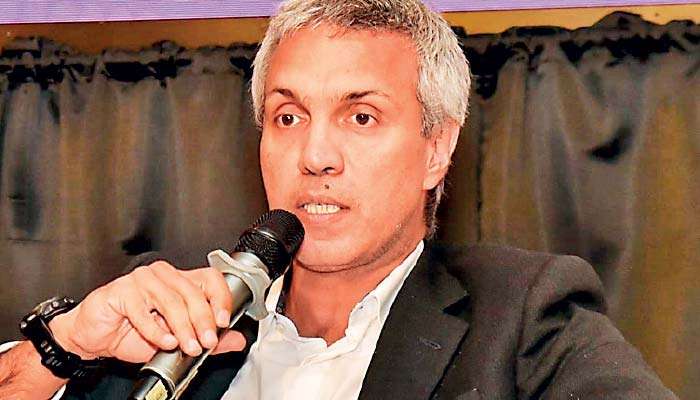
Revan Wickramasuriya
Director General of Colombo Port City Economic Commission
Ultimately, the overarching issue is that the Port City Economic Commission stands as an arbitrary structure created during the Rajapaksa administration. It was designed by bending the law to allow for unaccountable operation.
The problem, however, does not end there. The defining question now is why the current government, which swept to power on the promise of establishing good governance and a clean state mechanism, continues to perpetuate these opaque, inherently flawed Rajapaksa structures without any variation.
If the Colombo Port City is truly a territory subject to Sri Lankan law, it is the imperative responsibility of the current government to immediately investigate these irregularities and subject the Commission’s administration to rigid transparency. Failing that, while "good governance" slogans are chanted publicly, a separate set of rules is applied solely to the Port City, and the Sri Lankan people will be forced to accept that Colombo Port City is, indeed, a separate state that does not belong to Sri Lanka.
Sources:
Port City News Advertisements,
Parliamentary Hansards,
"The Leader" and "LankaLeader" web articles.