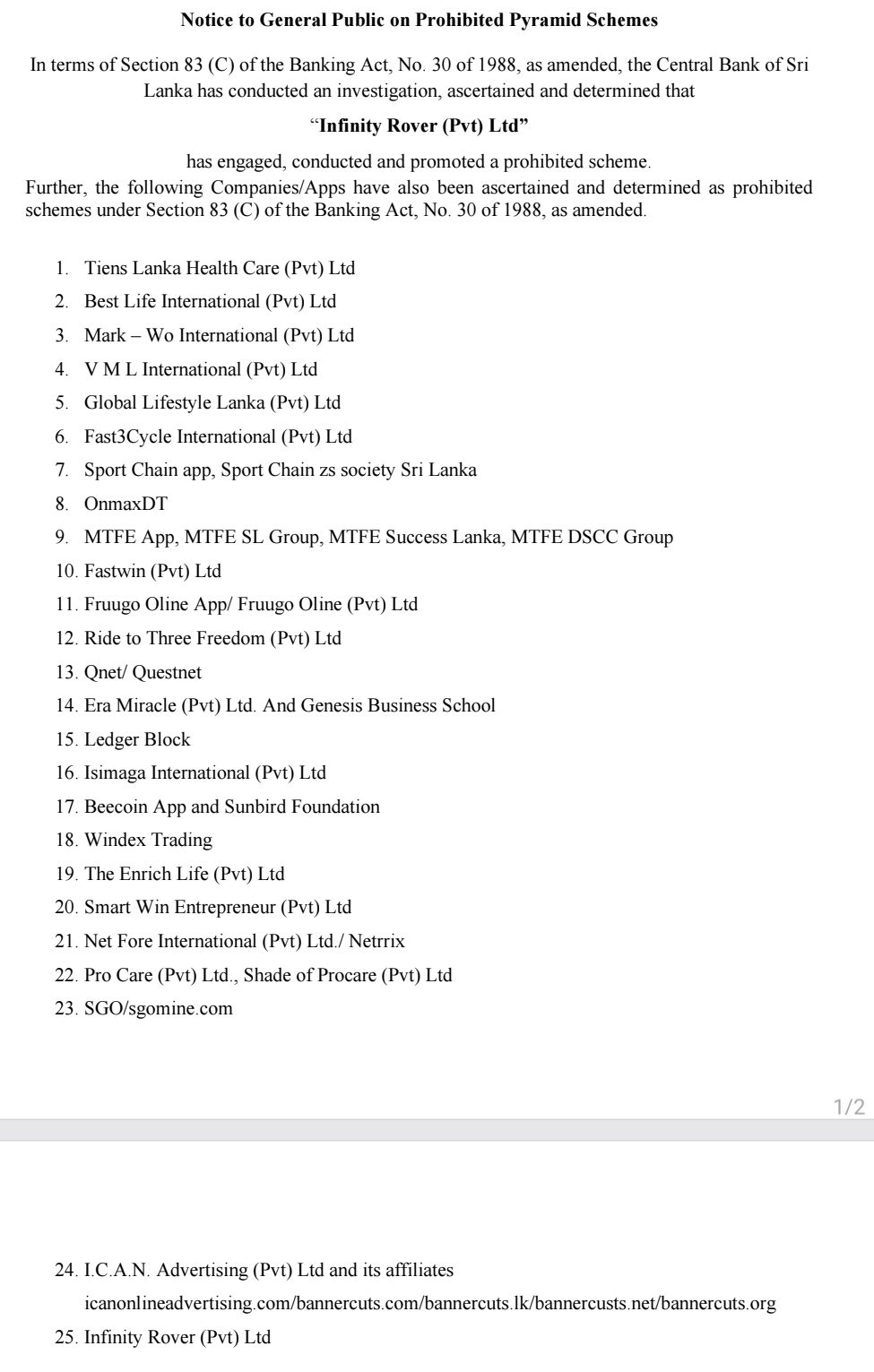
The Central Bank of Sri Lanka (CBSL) issued a public notice today (July 1), updating
its official registry of prohibited pyramid schemes. Following a statutory investigation under Section 83(C) of the Banking Act, No. 30 of 1988, as amended, 'Infinity Rover (Pvt) Ltd' has been formally identified as an illegal pyramid operation.
This latest regulatory update brings the total number of blacklisted entities to 25. Alongside the newly added Infinity Rover (Pvt) Ltd, the CBSL reiterated that operations such as Qnet/Questnet, MTFE App, OnmaxDT, Fastwin (Pvt) Ltd, Ledger Block, Sport Chain, and SGO/sgomine.com remain strictly prohibited. The CBSL also issued a stern warning, urging the public to refrain from participating in these unlawful schemes.
Crucially, this regulatory action follows our recent investigative exposures detailing the illicit asset networks of international pyramid mastermind Vijay Eswaran and his strategic proxy in Sri Lanka, Raju Radha. Our continued media campaign has compelled regulatory bodies to confront these deep-seated financial irregularities.
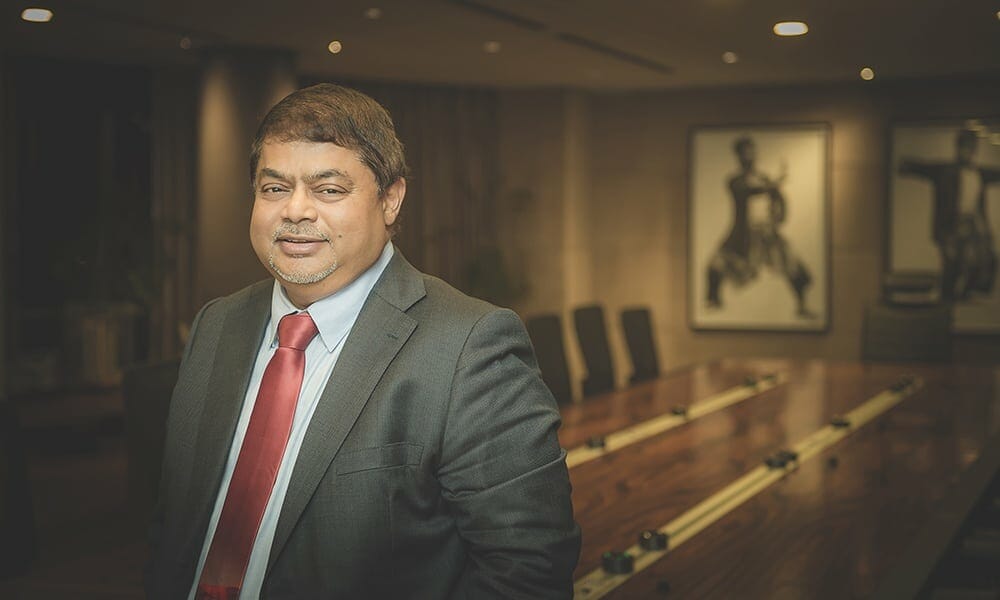
Vijay-Eswaran
However, a glaring institutional paradox remains. Despite the CBSL reconfirming 'Qnet/Questnet' as a banned entity in today's updated list, its multi-millionaire founder, Vijayeswaran S. Vijayaratnam—widely known as Vijay Eswaran—continues to operate and profit within Sri Lanka’s formal capital market without hindrance.
On paper, Sri Lanka possesses a robust legal framework against financial crimes. Under the Financial Transactions Reporting Act (FTRA) No. 6 of 2006, the Financial Intelligence Unit (FIU) holds sweeping powers to freeze suspicious assets, making it mandatory to report flagged individuals within two working days. Furthermore, the Proceeds of Crime Act (POCA) No. 5 of 2025 empowers the state to execute non-conviction-based civil forfeitures, allowing the seizure of criminal assets based on the balance of probabilities.
Yet, Eswaran masterfully exploits the 'corporate veil' to evade this legal dragnet. Despite facing multiple international arrest warrants-including an active 'Lookout' notice by the Mumbai Police Economic Offences Wing (EOW) for a Rs. 425 crore fraud-he maintains a staggering 71.6% majority stake in Asia Capital PLC, a prominent public company listed on the Colombo Stock Exchange (CSE).
He systematically evades asset seizure by shielding his investments behind a complex web of offshore holding corporations, such as the Malaysia-registered 'Fast Gain International Limited'. Because these funds enter Sri Lanka through formal banking channels as legitimate foreign remittances, and since no local court has convicted him, traditional anti-money laundering mechanisms remain paralyzed.
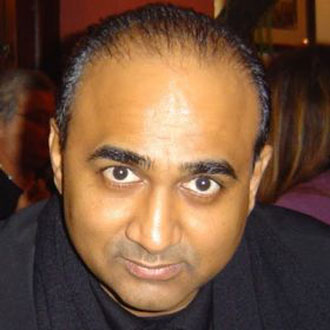
Ragu Radha
Operating at the epicenter of this controversial ownership structure is Raju Radha, the current Managing Director of Asia Capital PLC, who faces allegations of acting as Eswaran’s corporate proxy. However, internal financial records paint a more complex picture, suggesting Radha is not merely a nominal figurehead, but a calculating crisis manager.
In early 2026, Radha navigated Asia Capital through a perilous institutional crisis - a $6 million criminal breach of trust dispute filed in the Colombo Fort Magistrate’s Court by Japanese investors representing Singapore-based CC Trust Pte Ltd. Following two court dismissals, Radha orchestrated an amicable settlement by strategically relinquishing only the shares of the 'River House' hotel, preventing a hostile takeover of the entire hotel chain. Despite severe liquidity constraints, his aggressive corporate restructuring narrowed Asia Capital's net loss by 2026, keeping the embattled firm afloat.
Nevertheless, internal corporate maneuvering cannot absolve the state's underlying regulatory failures. If the CBSL’s updated notice re-affirms that QNet is an outlawed syndicate, the financial proceeds derived from its founder cannot be allowed to hide in plain sight. Why are these assets not being immediately frozen or seized under the POCA Act of 2025?
The Securities and Exchange Commission (SEC), the CBSL's Financial Intelligence Unit (FIU), and the Criminal Investigation Department (CID) must transcend superficial compliance. Unless Ultimate Beneficial Ownership (UBO) disclosure laws are made strictly mandatory for all listed entities, Sri Lanka will remain a safe haven for international economic fugitives, regardless of how many blacklists the Central Bank publishes.
#Samaara Paranavithana