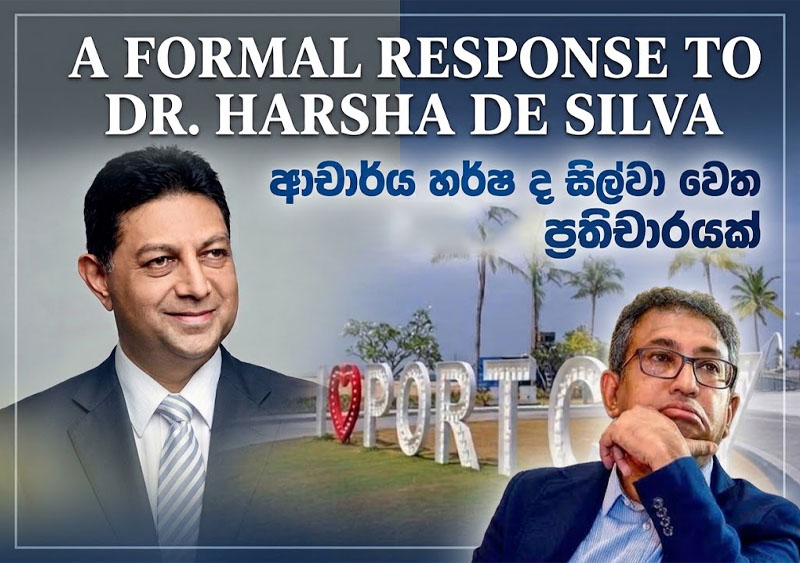
"A Formal Response to Dr. Harsha de Silva"
Recent media disclosures have ignited a fierce debate
regarding an allegedly irregular appointment within the administrative structure of the Colombo Port City. Amidst this crisis, the apparent silence of Dr. Harsha de Silva, Chairman of the Committee on Public Finance (COPF), prompted widespread journalistic scrutiny. Severe allegations even surfaced suggesting that this critical issue might be circumvented due to the shared alma mater of the COPF Chairman and the Chairman of the Port City Commission.
However, our latest sources confirm that the top management of the Port City, including its Chairman, has been summoned to appear before the COPF next week. Concurrently, in response to an investigative piece published yesterday on the Hari Deshaya web portal, COPF Chairman Dr. Harsha de Silva issued a formal statement clarifying his official stance.
Before proceeding to our critical analysis, it is imperative to reproduce the Chairman’s original statement verbatim to ensure contextual integrity:
"As Chairman of the COPF I reject the accusation that our committee has acted in any way to justify an inappropriate appointment to the Port City Commission as its head of legal operations. While it is not within the scope of our committee to examine the staff recruitment process of the PCC, which is entirely their responsibility, it is certainly within the scope of the COPF, the examination of procedures on how various fiscal incentives are proposed and approved for investments in the jurisdiction as such incentives have a direct bearing on public finance.
A recent matter of concern was how certain real estate companies were advertising various incentives to purchase apartments inside the Port City without first obtaining parliamentary approval for same. After the committee raised objections the PCC halted the said companies from advertising until approval was granted. Another matter, perhaps two years ago, was the committee’s refusal to accept a gazette issued by the PCC declaring a list of items that could be purchased duty free, once again without parliamentary approval. A long debate that ensued with regard to the powers of the PCC finally resulted in the said gazette being rescinded and the exit of its then head of legal operations. There have been other instances where the COPF had made observations that led to amending regulations.
All the above were matters related to public finance. Therefore, while the COPF has no control on who should head legal affairs at the PCC, our committee expects persons with requisite knowledge and experience are placed at responsible positions so that matters related to public finance are handled appropriately.
In any case the PCC is expected to be present at our committee’s hearings in the next couple of weeks and our members will have the opportunity to clarify any concerns regarding this matter during the session. I thank you on behalf of the COPF."
– Harsha de Silva, Chairman, COPF.
A Critical Rejoinder: Why the COPF Must Ensure Absolute Accountability
We have carefully reviewed the aforementioned statement by Dr. Harsha de Silva. We highly commend the decisive actions previously taken by the COPF—such as halting unauthorized real estate promotions—which assert that the Port City is not an independent enclave, but remains strictly subordinate to the financial supremacy of the Sri Lankan Parliament as enshrined in Article 148 of the Constitution. Furthermore, his assertion that direct intervention in the internal human resource recruitment process of the Commission falls outside his statutory purview is legally accurate.
However, drawing directly from the Chairman's own rationale, we argue that the current crisis within the legal division cannot be dismissed merely as an "internal administrative issue," absolving the COPF of its broader oversight responsibilities. Several compelling legal and administrative factors substantiate this position.
The Lesson of Precedent: Legal Vulnerabilities and Sovereign Fiscal Risk
As highlighted in the Chairman's statement, a severe regulatory failure occurred two years ago when the Commission unilaterally issued an illegal gazette detailing duty-free allowances without securing mandatory parliamentary approval. Following stringent intervention by the COPF, this gazette had to be rescinded. The direct consequence of this monumental regulatory failure was the immediate resignation of the then Head of Legal Operations.
Even a highly accomplished legal professional, holding an LLM in International Trade Law and possessing over two decades of corporate legal experience, found her position untenable in the wake of such a constitutional crisis. The unequivocal truth derived from this precedent is that even a minor legal oversight or misinterpretation by the Commission's legal division poses an imminent and catastrophic threat to the national economy and state revenue. Permitting a breach of Article 148 of the Constitution is not a human resource dilemma; it is a direct assault on national financial security.
The Collapse of Institutional Checks and Balances
Viewing the current crisis through the lens of this precedent reveals a disturbing reality. Presently, the Commission operates without a full-time Legal Director; instead, the Director of Commercial Operations has absorbed the duties of the legal head in an unprecedented 'role swap'.
In corporate governance and administrative science, a commercial division's primary mandate is aggressive revenue generation, investment attraction, and deal-making. Conversely, the legal division's fundamental purpose is to rigorously regulate those transactions, ensuring strict statutory compliance and risk mitigation. Consolidating both divisions under a single individual engenders a catastrophic conflict of interest. When institutional checks and balances are entirely dismantled, how can the protection of public finance be guaranteed during the dispensation of complex tax exemptions and duty-free privileges?
IMF Conditionalities and the Threat of Macroeconomic Tragedy
Furthermore, the Colombo Port City Economic Commission (Amendment) Act No. 1 of 2026 imposes stringent, time-bound regulations regarding tax expenditures and foreign exchange controls. These rigid legal frameworks must be executed meticulously to meet the critical structural benchmarks of the International Monetary Fund (IMF) Extended Fund Facility. Entrusting these profound statutory powers to personnel lacking specialized, demonstrated legal expertise within such a complex legislative environment will undoubtedly precipitate a macroeconomic tragedy for the national economy.
Therefore, when the Port City Commission appears before the COPF in the coming weeks, the Committee cannot remain passive, confining its inquiries to mere 'recruitment procedures'. Rather, it is an indispensable extension of the COPF's constitutional mandate to rigorously interrogate how this disastrous structural conflict between commercial objectives and legal oversight directly jeopardizes national financial security.
A Port City devoid of stringent legal discipline will not catalyze an economic renaissance; instead, it will detonate a massive landmine beneath the fragile Sri Lankan economy.